














HIKMICRO NEOS: A Smart Choice in the New Generation of Thermal Optics

Compact dimensions, high-sensitivity thermal imaging and intelligent image-processing technology come together in HIKMICRO’s new NEOS range — a series designed to make advanced thermal observation more accessible without stripping away the features serious outdoor users expect.

Thermal technology has changed dramatically over the past few years. What was once bulky, highly specialised equipment is becoming smaller, faster and significantly easier to use. At the same time, image quality has improved to the point where the real conversation is no longer simply whether a thermal device can detect heat, but how clearly it can translate subtle temperature differences into useful detail.

That is the territory into which HIKMICRO’s new NEOS series arrives.

Introduced in 2026, the NEOS family currently consists of three models — the NE25, NH25L and NH35L — providing different sensor resolutions, focal lengths and feature sets while sharing the same basic design philosophy: keep the unit compact, responsive and straightforward without sacrificing the technology that matters in the field.

More than simply seeing heat

One of the first specifications thermal users tend to look at is sensor resolution. It is important, but resolution tells only part of the story.

The NEOS range uses uncooled VOx thermal detectors with a 12 μm pixel pitch and 50 Hz refresh rate, while thermal sensitivity across the series is rated at NETD below 18 mK.

NETD — Noise Equivalent Temperature Difference — sounds highly technical, but its practical meaning is relatively straightforward. It describes how small a temperature difference the sensor can distinguish. Lower values generally mean the device is capable of separating finer differences in heat.

That becomes particularly important when conditions are less than ideal.

On a cold, clear night, a warm animal against a much cooler background can provide strong thermal contrast. But conditions are not always that cooperative. Warm ground, humid air, vegetation and changing temperatures can reduce the apparent difference between a subject and its surroundings. A highly sensitive sensor has more information available from which to construct the image.

HIKMICRO combines the NEOS sensor with its Image Pro 3.0 processing algorithm, which is intended to improve perceived detail and make objects easier to distinguish within the thermal scene.

The important distinction here is between detecting something and understanding what you are looking at. A distant heat signature may be visible long before enough detail is available for confident identification. Better thermal sensitivity and image processing help close that gap.

Shutterless viewing changes the experience

Anyone who has spent time behind conventional thermal equipment will be familiar with periodic image calibration.

In many thermal systems, the image momentarily freezes while the device recalibrates its sensor. It may only last a fraction of a second, but it can interrupt observation at exactly the wrong moment.

The NEOS series uses HIKMICRO Shutterless Image System — HSIS — specifically to address this. Instead of the familiar intermittent image freeze associated with traditional shutter-based calibration, HIKMICRO designed HSIS to maintain a more continuous view.

Alongside HSIS is Sync Pro, another HIKMICRO processing technology aimed at reducing the delay between movement in the real world and what appears on the display. HIKMICRO says the result is a smoother, more immediate viewing experience.

Individually, these features may sound like refinements. In actual field use, however, responsiveness matters enormously. Thermal observation often involves moving animals, scanning vegetation or following a heat source across uneven ground. A display that responds naturally and continuously reduces distraction and allows the user to concentrate on what is happening ahead.
Digital zoom without losing the plot

Digital magnification presents another long-standing challenge.

Unlike optical magnification, digital zoom enlarges information that has already been captured by the sensor. Push it far enough and the familiar blocky, pixelated appearance begins to emerge.

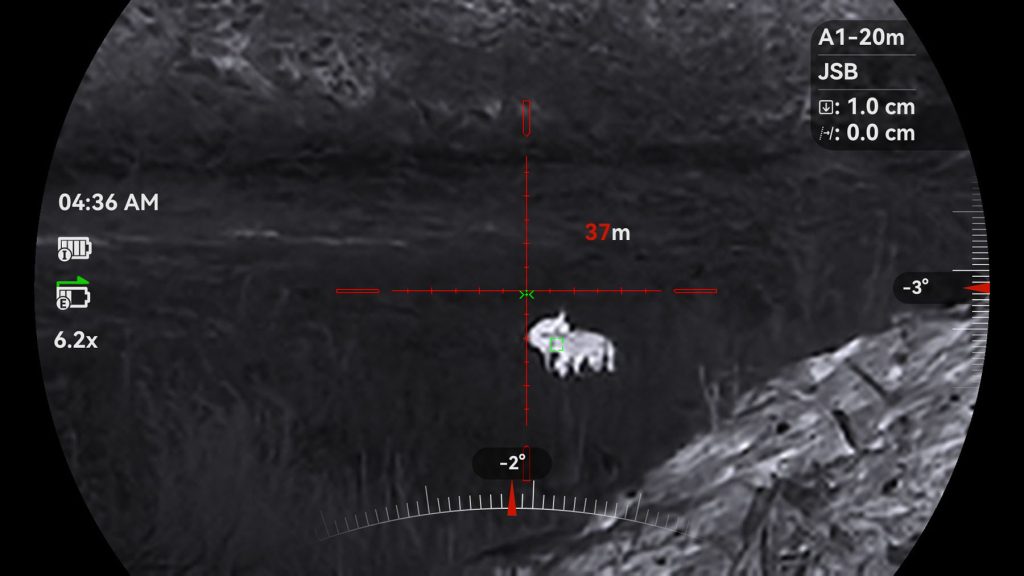
HIKMICRO’s Zoom Pro algorithm is intended to improve the way detail is rendered as digital magnification increases, reducing some of the degradation normally associated with heavy digital zoom.

It cannot magically create information that the sensor never captured, and users should always remember that native sensor resolution remains extremely important. What intelligent processing can do, however, is make better use of the information that is available.

That becomes particularly relevant when considering the three NEOS models.

Three NEOS models, three different roles

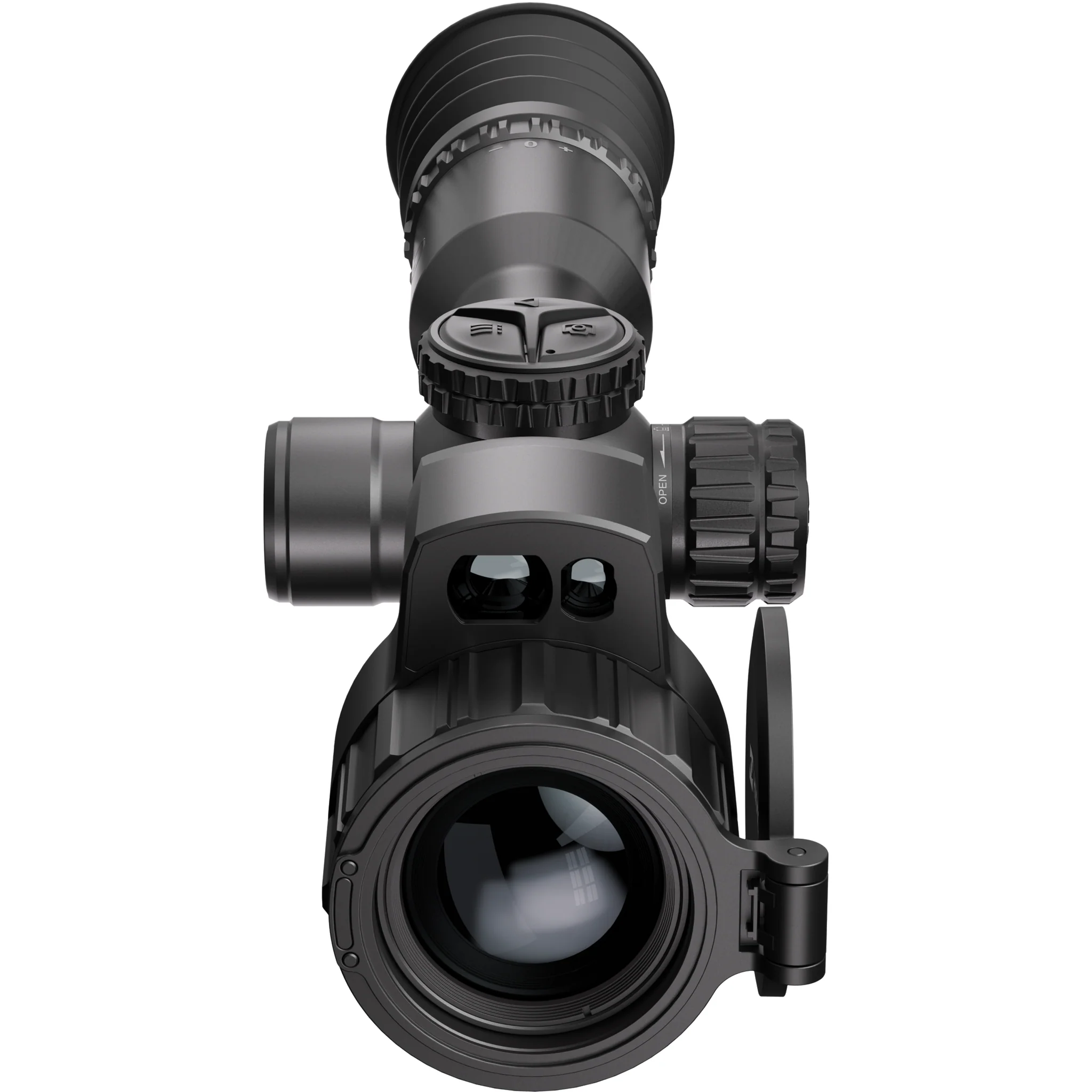
The entry point into the range is the NE25. It uses a 256 × 192 thermal sensor paired with a 25 mm focal-length lens. At approximately 540 g, it is also the lightest member of the family. HIKMICRO lists a thermal detection range of up to 1,200 metres under its specified test conditions.

Moving up the range, the NH25L increases sensor resolution to 320 × 240 while retaining a 25 mm lens. The “L” is significant: this model incorporates an integrated laser rangefinder together with ballistic-calculation functionality. It weighs approximately 550 g and has a stated detection range of up to 1,200 metres.

At the top of the current family sits the NH35L. Its 384 × 288 sensor and 35 mm F1.0 lens give it the strongest long-range capability of the three, with HIKMICRO specifying a detection range of up to 1,800 metres. It also incorporates the integrated laser rangefinder and weighs approximately 570 g.

Those detection distances should not be confused with identification or practical engagement distances. Thermal detection figures are generally measured under controlled criteria and describe the ability to detect a target-sized heat source. Environmental conditions, target size, vegetation, humidity and terrain all affect what the user will actually see.

Nevertheless, the three-model structure gives buyers a sensible choice: an accessible compact platform in the NE25, greater resolution and rangefinding capability in the NH25L, and additional sensor resolution plus a longer focal length in the NH35L.

Rangefinding built into the optic

Distance can be notoriously difficult to judge through thermal imagery.

Because a thermal image is based on temperature rather than visible light, many of the visual references the human brain normally uses to judge depth are reduced or absent. A featureless field viewed through thermal optics can make a target appear deceptively closer or farther away than it really is.

That is why the integrated laser rangefinder on the NH25L and NH35L is more than a convenience.

HIKMICRO specifies a maximum ranging distance of 1,000 metres, with the rangefinder operating at 905 nm. On these models, range information can also work with the device’s ballistic-calculation functionality.

From a fieldcraft perspective, however, technology should complement rather than replace good judgement. Accurate distance information remains valuable for observation, animal management and making responsible decisions, while users must still identify their subject positively, understand the environment beyond it and operate within applicable laws and safe practices.

A surprisingly large display in a compact body

Another feature that deserves more attention than it usually receives on a specification sheet is the viewing system.

NEOS models use a 0.49-inch AMOLED display with a 1920 × 1080 resolution, together with 55 mm eye relief.

The benefit of a larger high-resolution internal display is not simply prettier imagery. Thermal devices are often used for extended periods, and viewing comfort matters. A generous display makes menu information, reticles and thermal detail easier to interpret and can reduce the feeling of looking through a tiny electronic tunnel.

The NEOS also provides several thermal colour palettes, including familiar White Hot and Black Hot options alongside additional modes that can be selected according to conditions and personal preference.

Picture-in-picture functionality provides another way to maintain awareness of the broader scene while enlarging a selected portion of the image.

Compact dimensions make a real difference

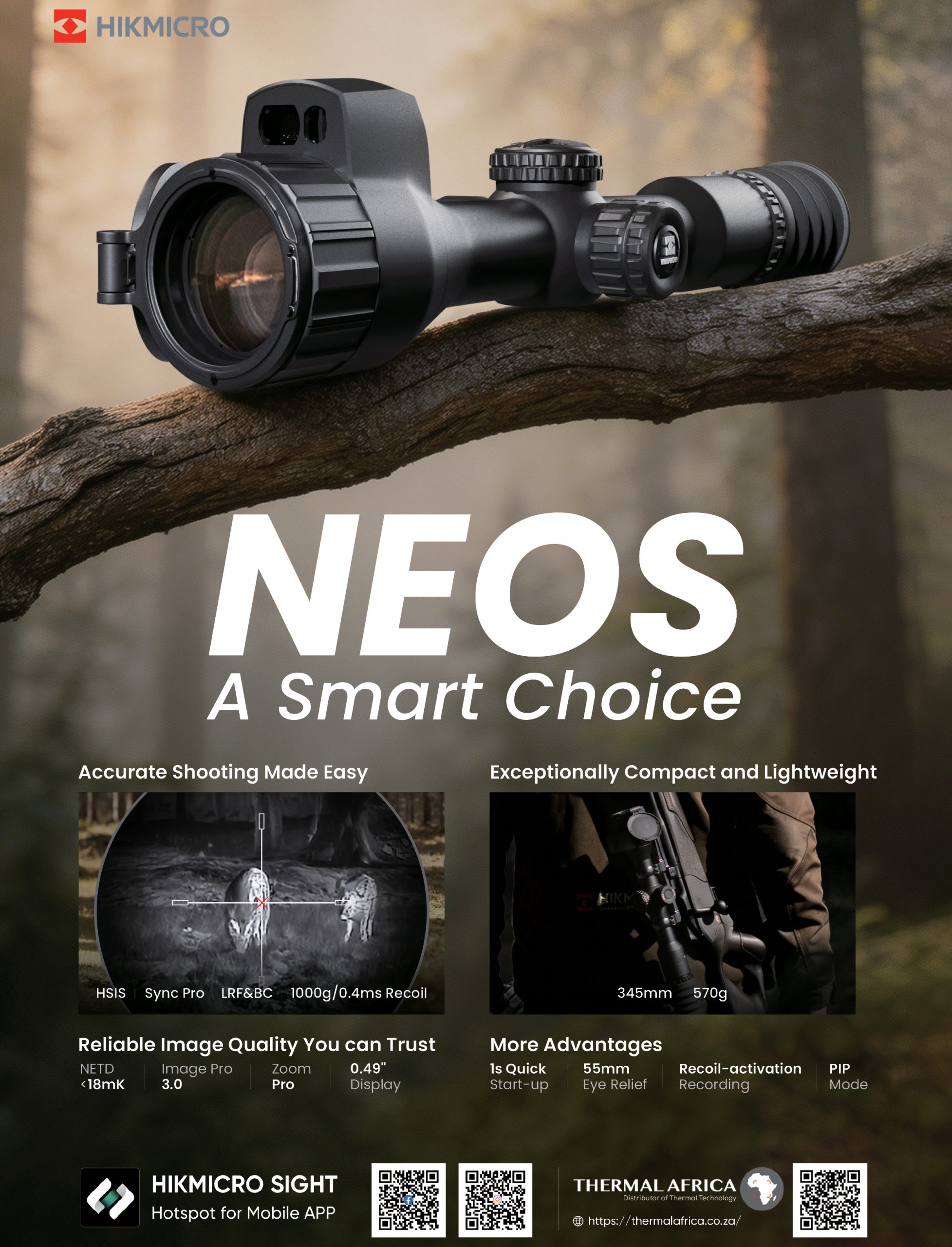
The advertisement describes NEOS as “exceptionally compact and lightweight”, and the numbers support that positioning.

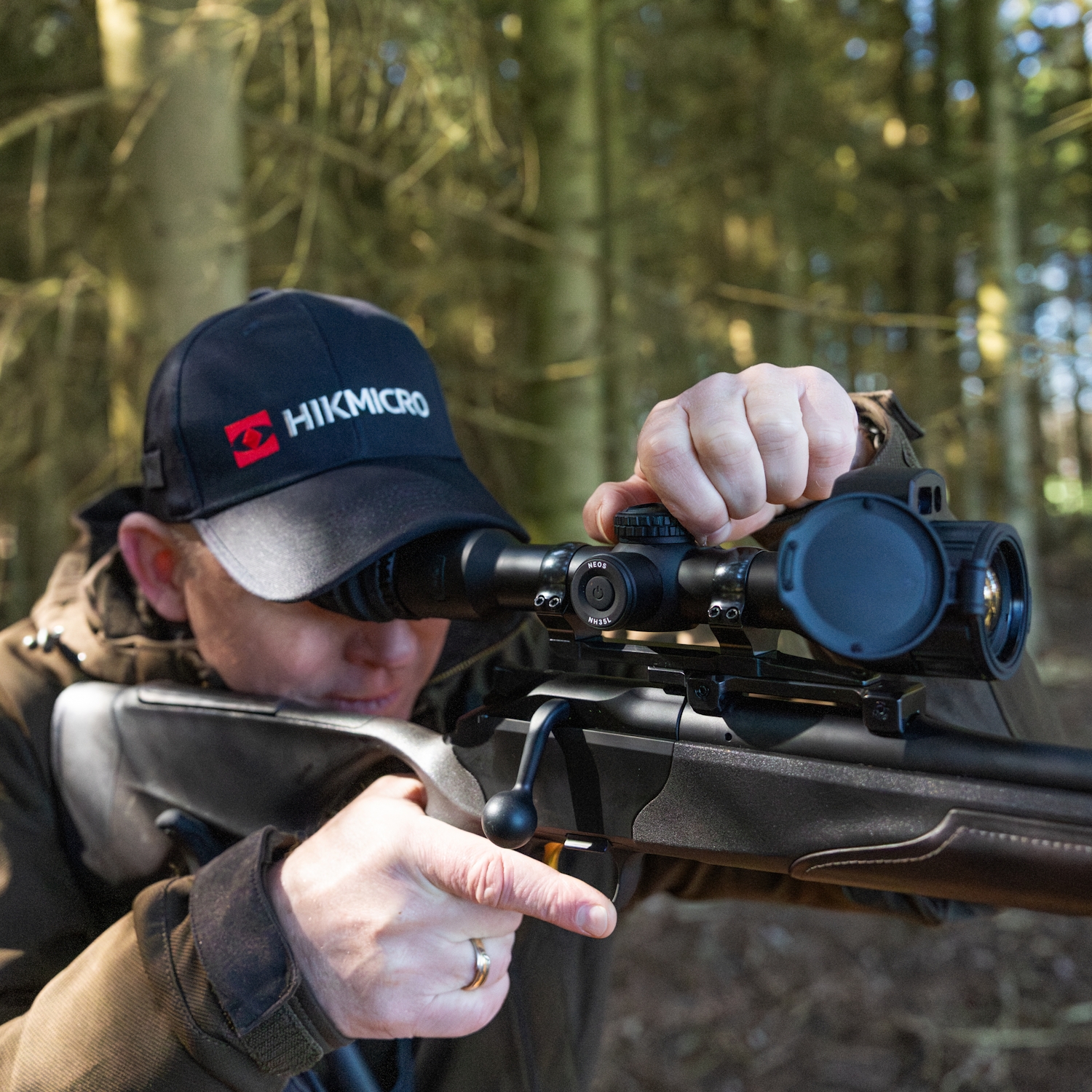
Depending on the model, the range weighs roughly 540 to 570 grams, with an overall length of approximately 345.6 mm. The design uses a standard 30 mm mounting format, giving it proportions closer to a traditional optical sight than many earlier-generation thermal devices.

That matters because additional weight positioned high on a rifle can noticeably alter handling. Saving several hundred grams may not look dramatic on paper, but it becomes much more apparent after hours of carrying equipment through the veld.

A familiar tubular profile can also make equipment setup and transport simpler.

Built for nights that do not end after an hour

Battery management is one of those subjects that receives little attention in advertisements but becomes critically important at 02:00 in the morning.

HIKMICRO uses a dual-power arrangement consisting of an internal rechargeable lithium battery together with a replaceable rechargeable 18650 battery.

Official operating-time figures vary by model and enabled features. HIKMICRO lists approximately 9.5 hours for the NE25, around 9 hours for the NH25L, and approximately 8 hours for the NH35L under the manufacturer’s specified test conditions.

The replaceable external battery is particularly useful because it gives the user the option of carrying charged spares rather than relying exclusively on an internal power source.

USB Type-C power support adds another practical charging option when travelling.

Recording the moment

Modern thermal equipment is increasingly expected to do more than simply provide a live image, and NEOS reflects that shift.

The platform supports on-board video recording, image capture, audio recording, built-in 64 GB storage, Wi-Fi hotspot functionality and recoil-activated recording.

For hunters and wildlife managers, recording capabilities have practical value beyond simply sharing footage online. They can allow an observation to be reviewed afterwards, help document animal behaviour and create a visual record of what happened during a particular encounter.

Integration with the HIKMICRO Sight app extends that digital ecosystem, while Thermal Africa highlights quick zeroing through the app as one of the NH25L’s features.

Designed for the realities of the outdoors

Electronic equipment intended for outdoor use needs more than impressive image specifications.

NEOS carries an IP67 protection rating and is specified for operation from -30°C to 55°C. HIKMICRO also lists recoil resistance of 1,000 g for 0.4 ms.

For South African users, protection from dust and moisture may be every bit as relevant as cold-weather performance. Fine dust, sudden rain, vehicle travel and long days in the veld can quickly expose weaknesses in poorly protected electronics.

Where the NEOS makes its strongest argument

Perhaps the most interesting thing about NEOS is not one headline specification.

It is the way HIKMICRO has combined several technologies that previously tended to push thermal equipment into larger or more expensive categories: sub-18 mK sensitivity, advanced image enhancement, shutterless operation, a large AMOLED display, compact dimensions and — on the NH25L and NH35L — integrated rangefinding.

The NH35L shown prominently in NEOS promotional material illustrates that philosophy particularly well. At around 570 g, it combines the highest-resolution sensor in the range with the 35 mm lens, integrated 1,000 m laser rangefinder, ballistic functionality, recoil-activated recording and the full suite of HIKMICRO image-processing technologies.

But the real strength of the NEOS family may be choice.

Not every user requires the longest focal length or highest-resolution sensor. Some will prioritise price and low weight. Others will value integrated distance measurement. For users spending more time observing at greater distances, the additional capability of the NH35L may justify stepping up.

That is what makes the name “A Smart Choice” particularly appropriate.

NEOS is not simply attempting to win the specification race. Instead, HIKMICRO has concentrated on features that directly influence day-to-day usability: clearer imagery, reduced latency, continuous viewing, manageable weight, useful battery life and a straightforward traditional form factor.

For hunters, farmers, wildlife managers and outdoor professionals considering thermal technology, the result is a range worth examining closely.

In South Africa, Thermal Africa is the official importer and distributor of HIKMICRO outdoor products, supporting the brand through its local dealer network, product support and warranty services.

As thermal imaging continues to become smaller, smarter and more capable, the HIKMICRO NEOS is a good illustration of where the technology is heading: less bulk, less interruption and more usable information when the light disappears.

Contact HIKMICRO For More Information

Leave a Comment

Scroll to Top