


















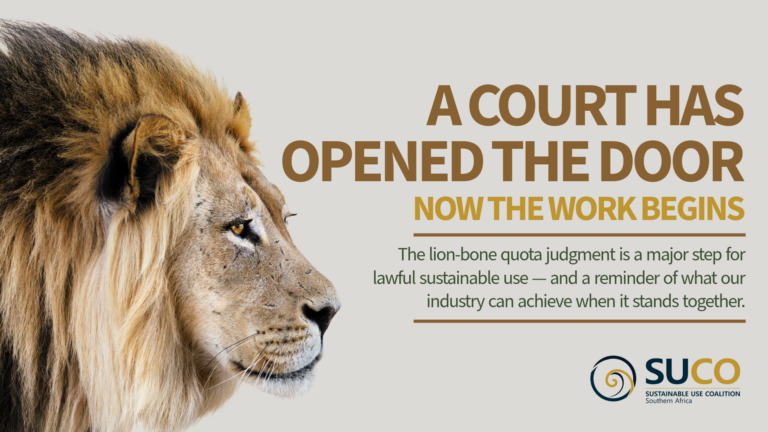
The lion-bone quota judgment is a major step for lawful sustainable use — and a reminder of what our industry can achieve when it stands together.
There are times when a court judgment is about far more than the immediate parties or even the particular species involved. Today’s judgment in the South African Predator Association (SAPA) case is one of those occasions. It is about the rule of law, accountable government and the simple principle that a Minister cannot avoid an uncomfortable statutory responsibility by doing nothing.
For years, South Africa’s captive-bred lion industry has faced an extraordinary position: operators holding lawful permits, and substantial stocks of derivatives already in existence, while the annual export quota process effectively stood still. Whatever one’s personal views on lion breeding, the law cannot simply be put on ice because a subject has become politically contentious.
On 29 October 2026, the Gauteng High Court in Pretoria found that the Minister has a legal duty to establish and communicate annual export quotas for the relevant captive-bred lion derivatives. The failure to do so for 2024 and 2025 was declared unlawful and set aside. The Minister was ordered to take the necessary steps to determine quotas for those years and annually thereafter, for as long as that duty remains in force.
Why does that matter? Because there is a world of difference between deciding, lawfully and on the evidence, what a quota should be and simply declining to decide at all. The Court held that the annual duty arises from South Africa’s CITES obligations, the specific lion annotation adopted at CoP17, and our own biodiversity legislation and regulations. A Minister must weigh conservation, welfare, scientific and economic considerations. But having difficult interests to reconcile is not a licence to walk away from the job.
This is not a judgment ordering the export of a single lion bone. Nor does it award the industry a particular quota. The actual number remains to be determined through the lawful process, including the Scientific Authority’s role. That distinction matters, and we should not pretend otherwise. What has changed is that a long-closed administrative door has been ordered open.
Credit belongs first and foremost to SAPA and the individual applicants who had the courage and resolve to take this matter to court. Litigation of this nature demands money, stamina and the willingness to endure considerable public criticism. They stood up not only for their own enterprises but for a principle with consequences across our wildlife economy. They deserve our sincere congratulations and thanks.
This outcome also demonstrates why the Sustainable Use Coalition of Southern Africa exists. Over a considerable period, SUCo-SA and its member organisations have worked alongside colleagues in the predator sector: sharing information, testing arguments, exchanging practical and legal insight and supporting one another when the pressure was on. The litigation was led by SAPA and its applicants, and we make no claim to their achievement. But the wider collaboration matters. Hunters, wildlife ranchers, breeders, outfitters, taxidermists and other participants in the value chain are stronger when they stop fighting these battles in isolation.
We must also keep our feet firmly on the ground. The judgment may be taken on appeal, and the consequences of any appeal will need careful attention. Nor is it beyond possibility that the Minister may attempt to determine a zero quota. A zero figure is not automatically unlawful; equally, it cannot be treated as an easy substitute for a properly reasoned, scientifically defensible decision. If a zero quota is adopted without a rational basis, it must be scrutinised and, where justified, challenged. That means preparing the evidence now, not waiting for the next setback.
The work ahead is therefore substantial: sound scientific material, credible stockpile information, a properly documented economic and conservation case, and continued scrutiny of the decisions that follow. We must be ready to engage constructively where government acts lawfully — and firmly where it does not.
The fight is not over. But this is a major leap in the right direction. A window of opportunity for lawful trade has reopened, subject to the next decisions and any appeal. More importantly, the Court has reaffirmed that public authorities must exercise the duties entrusted to them. That is a result worth defending, together.
Sustainable Use Coalition of Southern Africa (SUCo-SA)