| If the spots look like… | You are looking at… |
| Soft rounded islands on tan | Southern Giraffe |
| Hand-torn oak leaves | Masai Giraffe |
| Craft-scissors polygons on a white net | Reticulated Giraffe |
| Big rectangles with beige gaps | Northern Giraffe |

















Giraffe Coats: Patterns, Purpose and Conservation Part 2
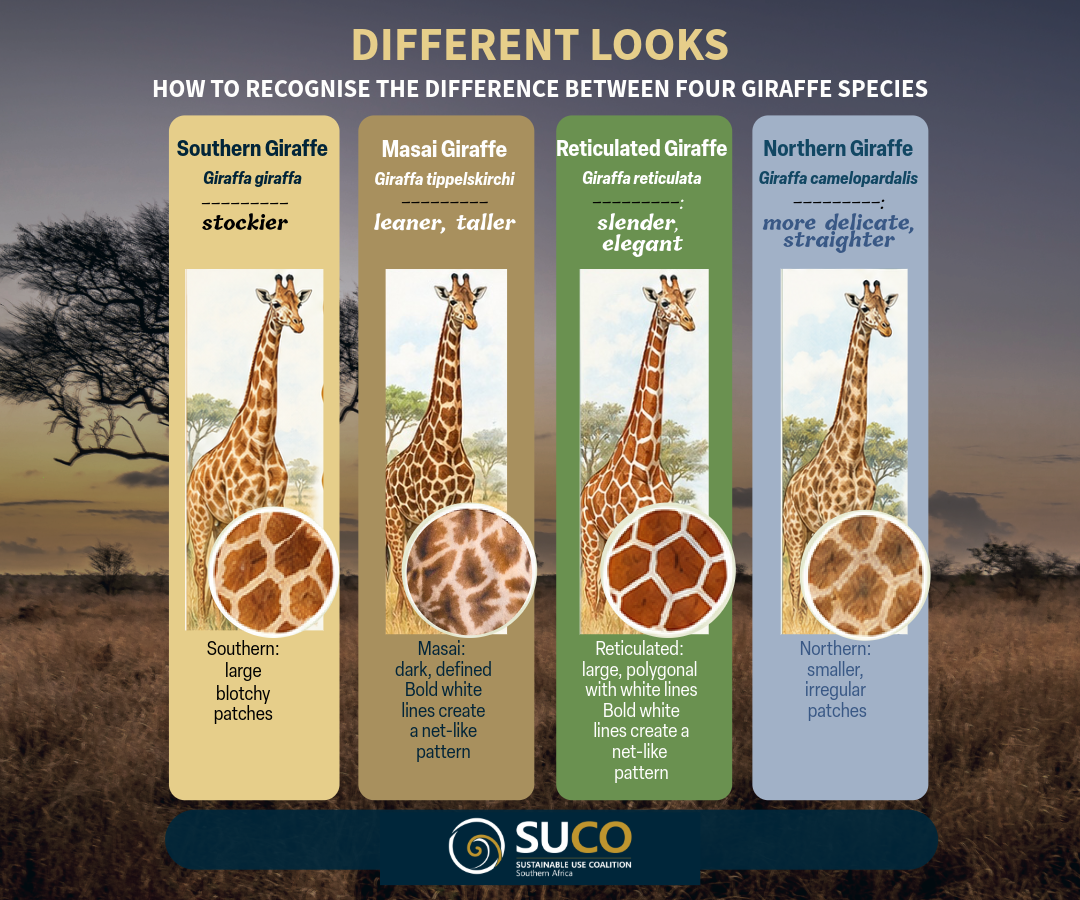

The overall style of the blotches splits cleanly by species. The IUCN now treats giraffes as four species.
Southern Giraffe | Masai Giraffe | Reticulated Giraffe | Northern Giraffe | |
Patches | Southern — Giraffa giraffa (the one in your drawing) Large, rounded or unevenly notched blotches in mid-brown on light tan. Spots shrink and scatter down the legs. | Masai — Giraffa tippelskirchi Jagged “vine leaf” or oak-leaf blotches with torn, starry edges. Darker chocolate spots on a cream-tan ground; the gaps are fuzzy, not a clean white grid. | Reticulated — Giraffa reticulata Sharp polygons, like stained glass. Dark chestnut to liver-brown plates with thin, bright white “net” lines. Spots stay neat down the legs. | Northern — Giraffa camelopardalis Large, often rectangular chestnut patches with thicker beige (not razor-white) channels. |
Subspecies | Two subspecies: South African — richer brown, slightly star-pointed edges Angolan / Namibian — often paler, even almost washed-out in the Namib; blotches more angular | Masai giraffe has two subspecies, The Masai giraffe (G. t. tippelskirchi) and the Luangwa giraffe (G. t. thornicrofti) are the two subspecies. The Luangwa giraffe is also known as Thornicroft’s giraffe. It lives in the Luangwa Valley region of Zambia, and it exists as a single isolated population in the South Luangwa Valley, with no natural genetic exchange with other Masai giraffe. This is consistent across sources. ITIS lists both as subspecies of Giraffa tippelskirchi, and San Diego Zoo Wildlife Alliance gives the same two. Its status has been disputed. It is sometimes treated as a species in its own right (Giraffa thornicrofti) rather than a Masai subspecies. That is why older material, and some pages online, label it differently. | Three subspecies differ: Nubian — boxy chestnut plates, sharper edges, white-ish lines Kordofan — smaller, more irregular, spots fade on the lower legs West African — lighter, fewer, more widely spaced spots | |
What to look for on a full body | Southern — rounded islands on tan; speckling continues to the hooves; often the palest of the four. | Masai — torn oak-leaf spots; usually the darkest and most irregular; often the tallest build. | Reticulated — clean polygons and a white net from neck to fetlock; the “neatest” silhouette. | Northern — bigger rectangles and wider beige gaps; legs can look cleaner than Masai or Southern. |
Range | The Southern giraffe (Giraffa giraffa) lives across southern Africa. It is the most widespread of the four giraffe species, with two subspecies. Angolan giraffe (G. g. angolensis) Most of Namibia Central Botswana Reintroduced into southern Angola, where it had died out locally Also recorded farther east, including parts of western Zimbabwe Animals in the northwest Namib are often very pale. South African giraffe (G. g. giraffa), also called the Cape giraffe Much of South Africa Eastern and northern Botswana Zimbabwe Southern Mozambique Eswatini Southern Malawi Northeastern Namibia Southwestern Zambia Southeastern Angola Together they occur in Angola, Botswana, Eswatini, Malawi, Mozambique, Namibia, South Africa, Zambia, and Zimbabwe. Habitat is savanna, open woodland, and arid scrub, including the Kalahari and the edge of the Namib. Parks have moved animals between these areas for decades, so the two subspecies are mixed in several places. A giraffe in South Africa is not always a pure South African animal. The species makes up nearly half of all wild giraffes, on the order of 69,000, and is listed as Vulnerable. | The Masai giraffe (Giraffa tippelskirchi) lives in East Africa, mainly south-central Kenya and across Tanzania. Core range Kenya: central and southern Kenya, including the Masai Mara and surrounding conservancies. It does not occupy the far north, where the reticulated giraffe is the local species. Tanzania: throughout the country, including the Serengeti, Tarangire, and Ngorongoro. Isolated and introduced populations Zambia: an isolated population in the South Luangwa Valley, often called Thornicroft’s giraffe (G. t. thornicrofti), treated as a subspecies of the Masai giraffe. Rwanda: Akagera National Park, from a translocation out of Kenya in the mid-1990s. That population is now over 160 animals. Habitat is open and wooded savanna, acacia and Commiphora bush, and the edges of miombo woodland. They avoid closed forest. The species is listed as Endangered; fewer than about 44,000 remain in the wild, down from roughly 71,000 a few decades ago. | The reticulated giraffe (Giraffa reticulata), also called the Somali giraffe, lives in the Horn of Africa. Its stronghold is northern and northeastern Kenya. Where it still occurs Kenya: the main population. Typical places are Samburu, Buffalo Springs, Meru, and the country north of Mount Kenya, including areas around Habaswein, Wajir, and Mnazini. It has also been seen in Tsavo East. Ethiopia: small, isolated groups that may still exist in the south. Somalia: small, isolated groups that may still exist in the south. Much of the old Somali range is poorly surveyed. Historically it was spread more widely across northeast Africa. Habitat loss and fragmentation have pulled it back. Habitat is acacia savanna, arid woodland, seasonal floodplains, and semi-desert. About 20,900 remain in the wild, down more than 40% from roughly 36,000 a few decades ago. It is listed as Endangered. More than 95% live outside government parks, mostly on community and private land in northern Kenya. | The Northern giraffe (Giraffa camelopardalis) is the rarest of the four species, with a little over 7,000 left. It lives in scattered pockets across West, Central, and East Africa. There are three subspecies. West African giraffe (G. c. peralta) Once from Senegal to Nigeria. Now only in Niger: the “Giraffe Zone” around Kouré, southeast of Niamey, plus a second group reintroduced to Gadabedji Reserve in central Niger. About 670 animals. Kordofan giraffe (G. c. antiquorum) Southern Chad (the stronghold is Zakouma National Park) Northern Cameroon Northern Central African Republic Northwestern Democratic Republic of the Congo (Garamba National Park) Western South Sudan About 2,400 left. Critically Endangered. Nubian giraffe (G. c. camelopardalis), including what used to be called Rothschild’s giraffe Uganda (Murchison Falls, Kidepo, Lake Mburo, Pian Upe) Western Ethiopia Eastern South Sudan Central and western Kenya, including animals moved outside the original range (for example Ruma) Historically the species reached Egypt and the Mediterranean in the north, and Senegal in the west. Those populations are gone. Habitat is savanna and open woodland, often in areas affected by conflict. |
Calves are born with the adult pattern already drawn; it only darkens with age. Males often go duskier than females. Desert Angolan giraffes can look almost patternless in harsh light. And because parks have moved animals around for decades, a “wrong” pattern in South Africa is sometimes a hybrid or an introduced lineage, not a misidentification.