



















Live Game Auction Trends

In May 2026, a total of 20 wildlife auctions were held, with just over 5 600 animals sold, generating auction turnover in excess of R130 million. This serves as a clear indication of the sector’s resilience and robustness, despite ongoing challenges posed by Foot-and-Mouth disease (FMD), regulatory and permitting constraints, and broader governance-relatedcomplexities affecting the industry.

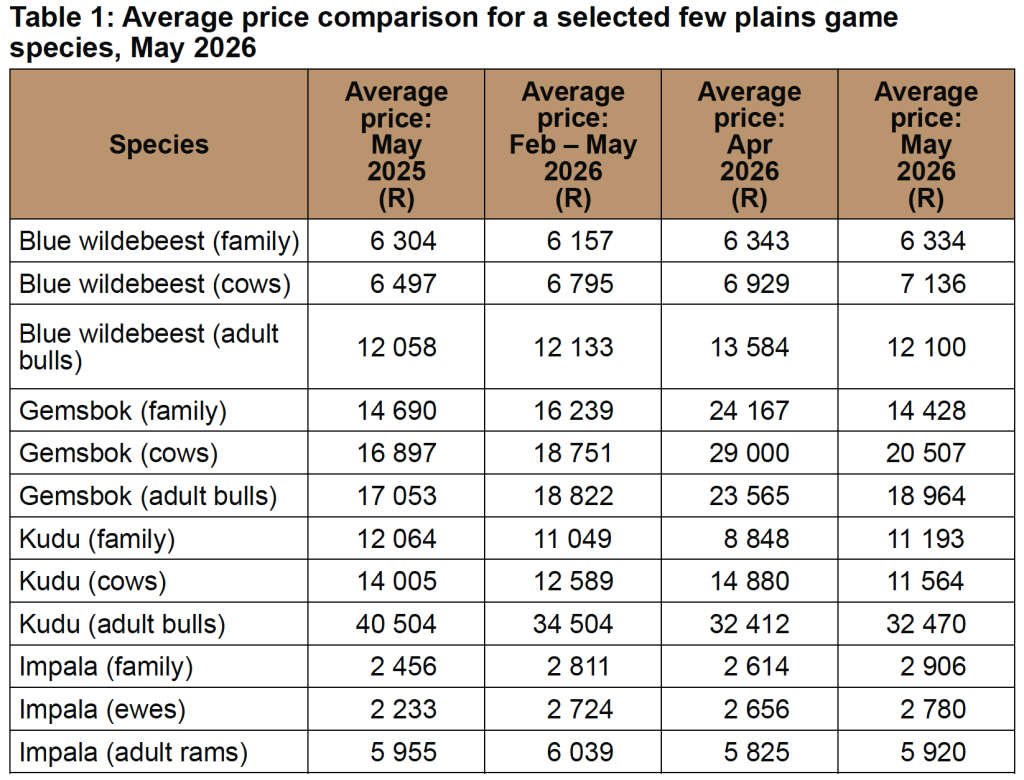
 Most of these governance and administrative challenges are not new; they have significantly increased the transaction costs of doing business in the wildlife sector for many years. More importantly, they continue to constrain the industry’s ability to fully leverage South Africa’s natural comparative advantage in wildlife resources and to translate it into a sustainable competitive advantage in both domestic and international markets.  Addressing these inefficiencies remains critical to unlocking the sector’s full economic potential and supporting its long-term growth and competitiveness, particularly amid increasing competition from other markets. This competition is unlikely to remain confined to neighbouring countries such as Namibia, which continues to strengthen its wildlife offering. There is also the possibility that international markets, most notably the United States, could emerge as competitors, as wildlife breeders have made considerable strides in the breeding, marketing, and commercialisation of species indigenous to Africa and Southern Africa. This development marks the beginning of what is likely the globalisation of the wildlife industry and serves as a reminder that South Africa’s historical advantages cannot be taken for granted.  While auction activity and turnover remain encouraging indicators of sector resilience, price movements often provide a more nuanced reflection of market sentiment. Based on price trends for selected plains game species, the market remains characterised by relative stability (Table 1). Blue wildebeest prices, for example, remained largely unchanged compared with both May 2025 and the months leading up to May 2026, indicating a well-balanced market with consistent demand. Similar trends were observed across most of the species analysed, with price fluctuations largely attributable to factors such as the origin of the animals, auction-specific dynamics, lot sizes, the age of the animals, and the quality and genetic composition of the animals offered. 

Notwithstanding this overall stability, there are indications that prices for adult male animals may come under pressure in the coming months, with the first signs of softening already evident in the latter part of May 2026. This trend warrants close monitoring, particularly given the important role that male animals play in driving market value across the species. The notable fluctuations observed in gemsbok prices can largely be attributed to differences in origin and adaptation. Gemsbok originating from and adapted to the northern parts of the country continue to command a premium over animals marketed in the central regions, resulting in higher average prices for certain categories. 

The opposite is true for kudu, particularly kudu bulls, where animals of comparable quality frequently fetch lower prices in the central parts of the country than in the northern parts. This pattern is not unique to gemsbok and kudu but is evident across several species. In many instances, animals adapted to heartwater-endemic areas attract a premium, largely due to their relative scarcity. It is also worth noting the notable increase in the number of sub-adult male animals offered at auction over the past month. This trend is likely price-driven, as the discount between adult and sub-adult males is currently not large enough to discourage sellers, particularly for animals within 12 to 18 months of reaching maturity. 

Furthermore, prevailing auction prices offer an attractive alternative to hunting, especially for sub-adult males, thereby encouraging producers to channel a greater proportion of these animals through the auction market. The resulting increase in supply may, however, contribute to additional price pressure in the short term. 

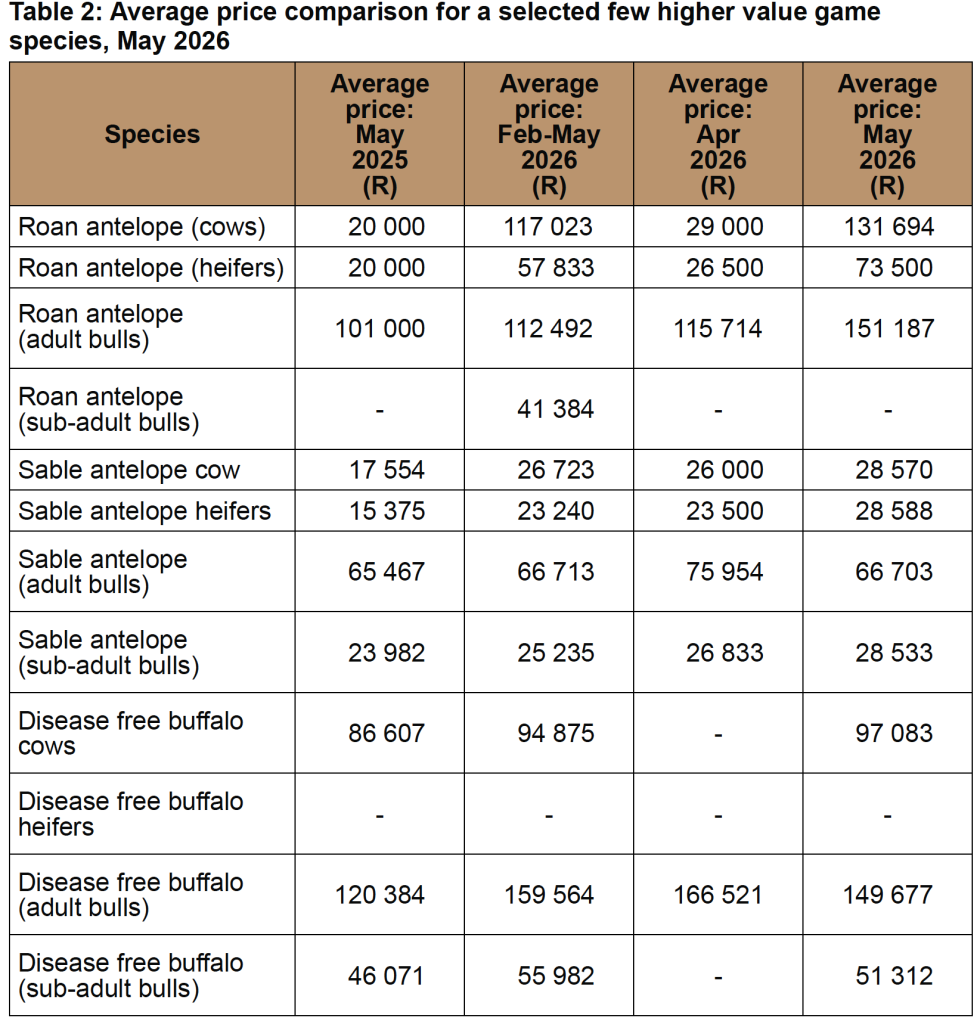
Price for higher value species tend to fluctuate more than that of plains game species mainly because of genetics/ quality of animals offered to be auction during a specific period. Caution should therefore be taken when interpreting prices on sight value, as movements are often misleading. However, the latest market price trends suggest a general upward movement in the prices of similar quality animals, mainly as a result of an increase in the floor price. Ceiling prices remains intact, with little to no positive price movement on the upper end of the price curve. What is also interesting to note, although not presented in the table, is the stabilization in the number of adult and sub-adult males offered to be auction, compared to a notable decline in the offering of female animals, both adult and sub-adult or heifers. This trend is most notable in terms of buffalo and sable antelope, with the number of female animals that are sold on auction that have significantly declined. This is unlikely to be the result of any significant decline in population numbers. In the case of buffalo, the combination of FMD-related risks, permit requirements, testing and bleeding protocols, and the prevailing price levels for commercial-quality animals has likely discouragedparticipation in the live market. Under these circumstances, alternative marketing channels, particularly hunting, may offer more attractive returns to producers. In contrast, the situation in the sable antelope market appears to be more closely linked to price incentives. At current price levels, many breeders may find greater value in retaining animals and expanding their herds rather than marketing them through auctions. However, the recent upward movement in prices could encourage additional animals to enter the live market, particularly sable cows and heifers, as producers seek to capitalise on improved market conditions.

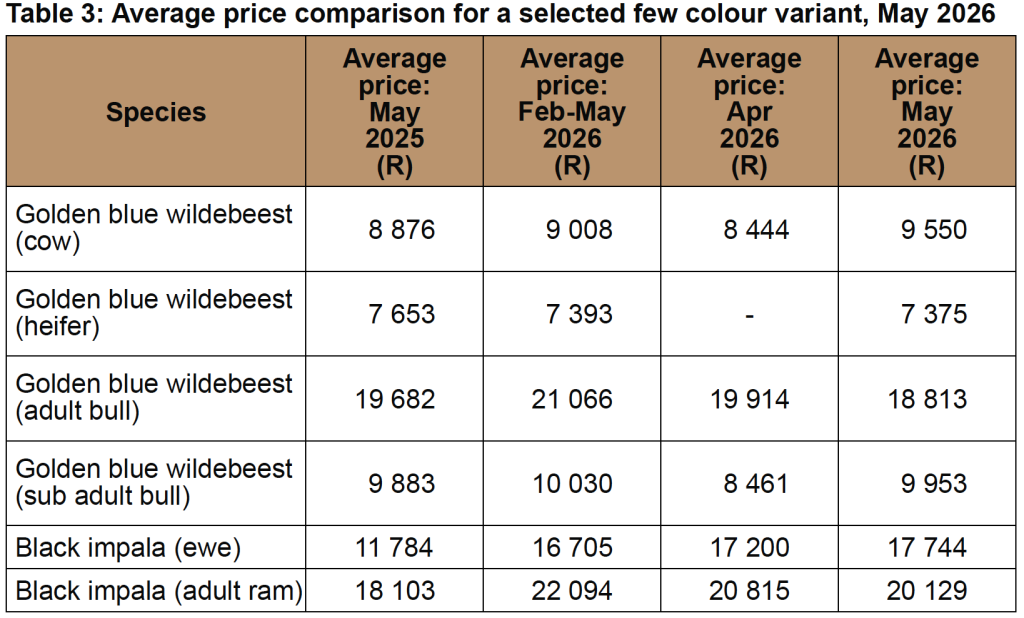
Colour variants remain among the standout performers in the wildlife market, supported by strong and sustained demand across most variants (Table 3). Breeding colour variants continues to offer an attractive and profitable alternative to their common counterparts, encouraging ongoing investment by breeders. Furthermore, the recent surge in prices for species such as dappled impala has provided additional stimulus to demand for other sought-after variants, including black impala and white-flanked impala. Current market indicators suggest that prices are likely to remain firm, at least in the foreseeable future, supported by favourable demand and a relatively limited supply of quality animals. 

The market for golden wildebeest, however, appears to have reached a degree of maturity, with prices for commercial-quality animals showing signs of plateauing. In contrast, substantial price variation remains evident in species such as saddleback blesbok and king wildebeest. For these animals, price formation is influenced more by coat colour, pattern quality, and overall visual appeal than by horn length alone, which tends to be the primary value driver for many other species. As a result, exceptional animals continue to command significant premiums, while average-quality animals trade at considerably lower levels.

Prices for other species, such as nyala and tsessebe, are also trading at levels moderately higher than those recorded a year ago. As a result, the number of animals presented at auction has increased, particularly in the case of nyala females, as producers seek to capitalise on favourable market conditions. This response is consistent with normal market behaviour, where improved prices incentivise greater participation and increased supply. 

Despite generally favourable price levels, the number of animals offered in certain categories, including giraffe, rhino, and smaller antelope species such as klipspringer, duiker, suni, and steenbok, remains lower than in previous years. The decline in the supply of smaller antelope may, in part, reflect a broader shift away from intensive breeding systems toward more extensive wildlife production practices, which present additional challenges in management, capture, and marketing, while also exposing them to greater predation risk, both of which can reduce the number of animals available for sale. 

For rhino, ongoing security concerns and the persistent threat of poaching may discourage wildlife ranchers from publicly advertising or marketing animals on open auction platforms. Consequently, a greater share of transactions may be occurring through private treaty sales or other less visible marketing channels. While auction numbers for these species have declined, this should not necessarily be interpreted as a decline in population numbers. Rather, it is more likely a reflection of changing production systems, evolving marketing preferences, and risk management considerations that increasingly influence decision-making within the wildlife industry. 

Scroll to Top