
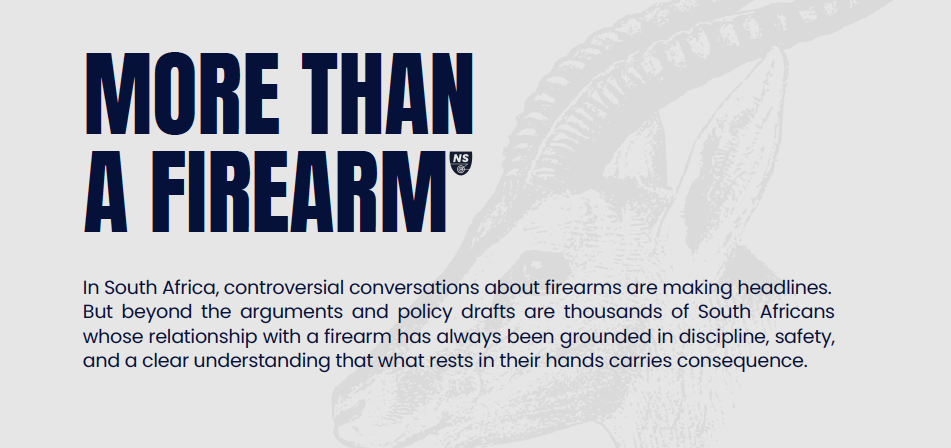
At Natshoot, we believe responsibility begins long before a licence is approved or a trigger is pressed — in conversations around the table, in hours spent training, in the mentorship of a parent, coach, or instructor who insists that character matters more than calibre.
FOR MANY IN THIS
COUNTRY, IT HAS
ALWAYS BEEN
MORE THAN A FIREARM.
It is the parent who teaches a child that safety comes before curiosity. The sport shooter who spends weekends refining grip, breathing, and trigger control in pursuit of precision. The farmer who checks fences at dusk and understands the responsibility of protecting livestock and family. The woman who trains consistently to protect her own safety. The hunter who studies wind, terrain, and animal behaviour long before hunting season. These are ordinary citizens taking accountability for, and enjoying, their discipline. In responsible circles, safety is not compliance for the sake of paperwork; it is proper firearms culture. It is reinforced in clubhouses and on firing lines. It is corrected immediately when standards slip. It is passed down from one generation to the next. A first firearm is never handed over lightly. A first hunt is never treated casually. There is a gravity to that moment: the quiet before a shot, the understanding of what it means to take responsibility for an outcome that cannot be undone.
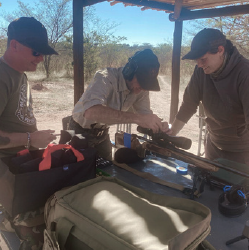
In hunting communities especially, that gravity extends beyond the trigger. It includes respect for life, for the land, shot placement, sustainable use, and for ensuring that the animal is utilised fully and purposefully. This is stewardship. Around this heritage exists an entire ecosystem built on discipline and structure. Gunsmiths who take pride in precision craftsmanship. Instructors who refuse to cut corners. Range officers who enforce standards. In South Africa, controversial conversations about firearms are making headlines. But beyond the arguments and policy drafts are thousands of South Africans whose relationship with a firearm has always been grounded in discipline, safety, and a clear understanding that what rests in their hands carries consequence. Associations that invest in training, youth development, and compliance education. Competitive shooting bodies that measure excellence in millimetres and milliseconds. Conservation models funded through lawful, regulated activity that supports habitat and wildlife management. It is a fully integrated community.
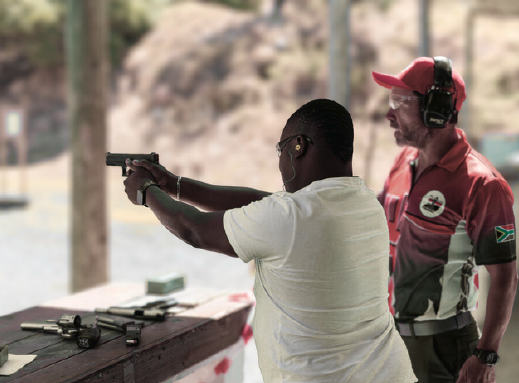
None of this erases the very real challenges our country faces. Violence is a serious problem. Criminal misuse of firearms causes harm that no responsible owner dismisses. But conflating criminality with lawful, trained, compliant citizens oversimplifies a complex issue. The individuals who obtain competency certificates, renew licences on time, store firearms securely, and train repeatedly are not the culprits; they are active participants in a structured, regulated discipline. When tension rises, responsible owners do not default to outrage. They return to standards — checking storage, revisiting safety rules, mentoring more carefully, training more intentionally, and reinforcing that a firearm is never a toy or a shortcut to power, but a tool that demands maturity, knowledge, and respect. To those who continue to defend lawful ownership and uphold procedural fairness through measured, principled engagement — thank you. Your work reinforces the standards that define this community.
Lawful owners are not the
problem; they are citizens
who choose responsibility
over recklessness.