Buck fever lechwe - Willie Vermeulen
“Don’t overthink it, but consume every bit while you are in it.”
My good friend and colleague, Kevin, and I were working on a project in Zambia’s Copperbelt with a pay weekend coming up. Without firm plans for something to do over this four-day break, we comfortably fell into familiar territory: chatting and dreaming about the things we love, namely hunting, fishing and family – in no particular order, of course!
I remember discussing what species of Zambian antelope I would still love to hunt. A short while later, the hunt for lechwe in the North-Western region of Zambia was confirmed through Ntengu Safaris. As it turns out, Kevin can organise like no other. The weekend could not come soon enough. We shut down our site on Thursday midday and made our way from Kitwe to Solwezi, arriving at the Cuturi’s Kalumbila Agricultural and Wildlife Conservancy well after dark. This was where we met with Arturo Cuturi.
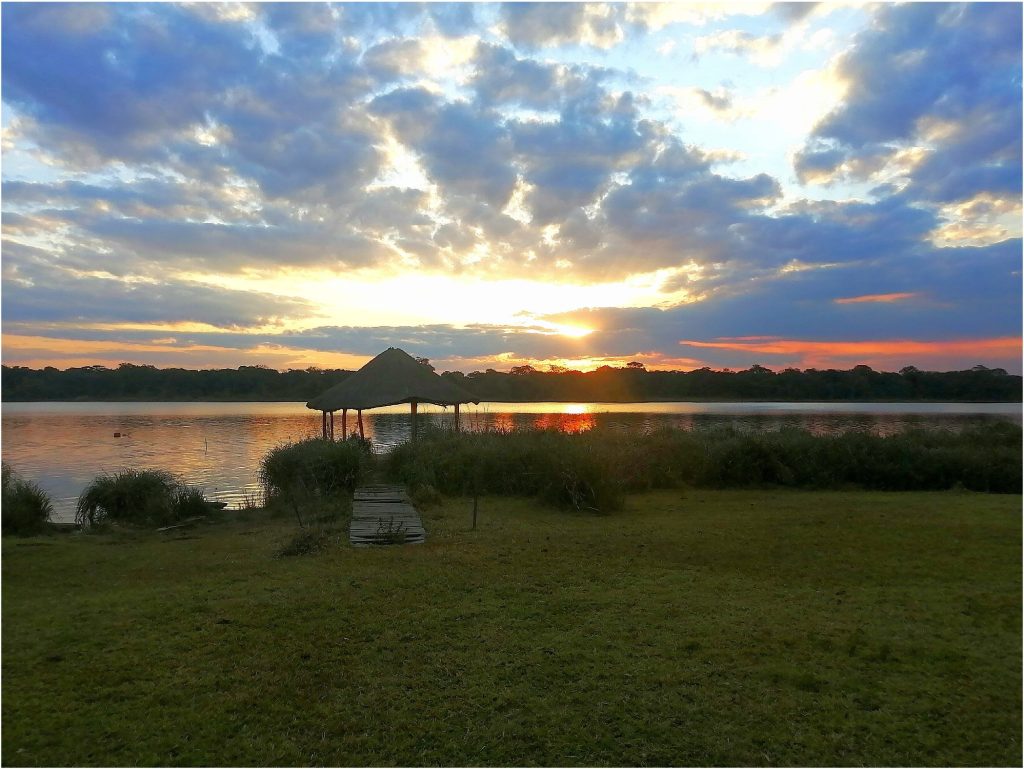
A brief introduction followed, and we were settled in for the weekend ahead. To our surprise, we found ourselves in a well-equipped farmhouse overlooking a large dam, with a perfectly placed firepit under the African skies that night. A couple of cold Mosi beers, ribeye steak and discussions of what the next day would bring, flooded the night.
The following morning, our internal clocks woke us at around 4 am. With a cup of coffee in hand, daybreak confirmed that we were in a piece of heaven on earth. Arturo came to pick us up shortly after. We were to use one of his rifles for our hunt and he had to confirm that we could at least punch a hole in paper at an adequate distance before going afield.
On arriving at the “shooting range”, we saw that our plans for some target shooting hadn’t been communicated to all who mattered: a big herd of buffalo occupied the range for the morning. We saw one of the most characteristic buffalo bulls I had ever seen – old, with trenched wrinkles on his face, almost hairless, hard-bossed and worn, rounded-off tips. He was a sight to behold; the ultimate dagha bull.
Not wanting to disturb the buffalo, Arturo decided to take us to a secluded part of their property to sight in the rifles (and us). We saw an abundance of plains game species, with gigantic sable and roan antelope standing out in the miombo thickets. We were in awe and it felt like we were in a wildlife paradise. Arturo had Kevin and me shoot with his Mauser M12 in .270 Win, equipped with Swarovski optics and fed with 150-grainers. We concluded the responsible act, and we were off to the dambos (shallow wetlands and floodplains that cut through the miombo woodlands) in search of Kafue lechwe.
There was an abundance of wildlife in and around the dambos – puku, Chobe bushbuck, lechwe and so many more around each bend. Our approach was to travel alongside the dambos, park the Cruiser, stalk in and then glass the area in search of representable, lone lechwe rams past their prime. Kevin was up to shooting first. I remember us telling each other the previous night that we had enough time not to shoot the first lechwe we saw. So much for that.
Driving through a floodplain, we spotted a lone ram at a distance. With only a glance at him, Kevin announced, “That is my ram.” Arturo confirmed that there were bigger rams on the property, but that he met the criteria, and it was up to Kevin. As we hunters know, if it speaks to you, no other person is going to change your opinion. Arturu parked the Cruiser and grabbed his shooting sticks. He and Kevin put in a short stalk. I was standing on the back of the Cruiser, watching the hunt unfold. The sticks were out and Kevin was on them with the 270. in due course.
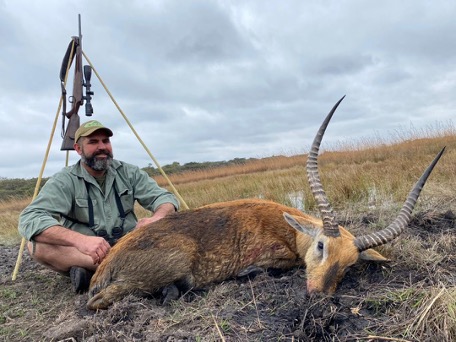
At the crack of the shot, the lechwe buck jumped forward and took off at speed. The shot was slightly back but it slowed him after roughly 100 metres. By now, I was standing next to Kevin and Arturo, with the ram facing away from us. I told Kevin to give him a spine shot for assurance, and he did just that. As the bullet struck, the ram disappeared in a vapour of water on his skin, and he was down. While walking up to him with shaking hands due to impeding buck fever, Kevin was overwhelmed with excitement and filled with joy.
On closer inspection, his ram proved to be an absolute stunner with a bright reddish coat and an impressive, thick set of flaring horns with notable ivory-white riffled rings spreading from the base to the tips. We took our time with a compulsory photo session to capture the imprinted memories.
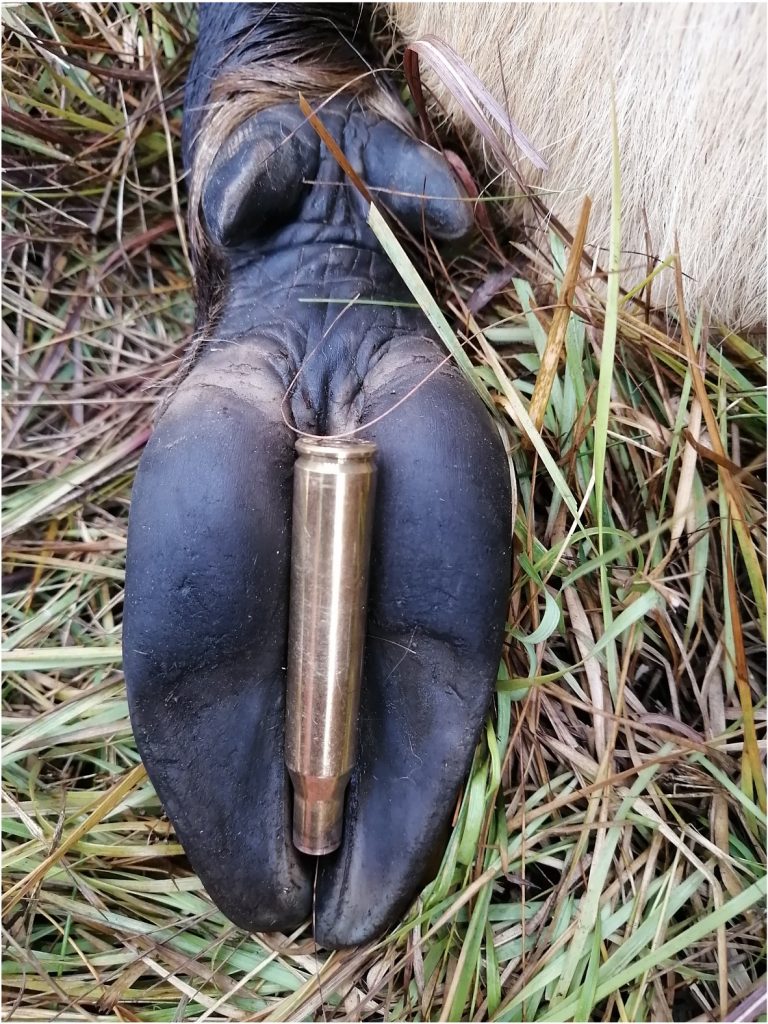
Arturo suggested leaving the ram in the wetland to quickly inspect a dambo close by where he had previously seen a notable ram. We reached the dambo and drove along the edge when I spotted what I thought to be a confusion of guineafowl. (The irony of the collective noun in this case is not lost on the author.) As we approached, I realised that I was staring at a family unit of no less than 20 ground hornbills – a rare sight in the parts of Africa I have travelled to, and a true testament to the conservation efforts of the Cuturi family.
I was still watching the ground hornbills when Arturo spotted what we were after. A lone ram was standing in the centre of the dambo with lyre-shaped horns rising up and back into the skyline. He was a sight to see and there were no second thoughts – my heart was caught off-guard. In my eyes, he was what lechwe hunting dreams were made of. We were exposed with no cover for an approach, and his vitals were obscured by thick wetland grass. All of a sudden, I felt a slight breeze in my neck, and seconds later, the ram bounced off and out of sight. My heart dropped into my shoes, and I thought it was over.
Arturo was still confident that he might stay in the area and suggested we drive around the dambo to get the wind right. We drove a few hundred metres to a crossing and turned to the opposite edge, where we thought we saw him disappear. There, we parked the Cruiser behind a large anthill on the edge of the dambo. Arturo and I slowly climbed the anthill to scan the area with Kevin and one of the trackers observing from behind. As we peeked over the top, the ram was standing a mere 100 metres away, oblivious of our presence.
Arturo immediately had me on the shooting sticks and I instinctively found the ram in the Swarovski’s crosshair. In that moment, I experienced the most severe case of buck fever ever! My eyes started blurring, my entire body shivering to the extent that I had to take the rifle off the sticks. I looked back at Kevin holding his phone, recording what was unfolding. Neither he nor Arturo could keep their laughter to themselves. Who could blame them? It was actually ridiculous, but I couldn’t control it!
I can’t really remember Arturo’s exact words, but it was something along the lines of “Take your time; he is not aware of our presence.”
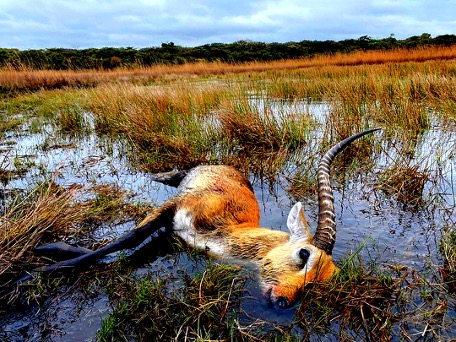
It felt like hours for my brain to settle my body, but I got back onto the sticks and took the shot at the vital triangle. The thump of the shot was affirmative, but the lechwe’s reaction not so much. He ran off and came to a halt at approximately 50 metres, when I gave him a second shot. My “buck fever” lechwe was down! We walked up to him and found him in a small seepage pond; he was a magnificent-looking specimen. I couldn’t feel more blessed to hunt him in his natural habitat.
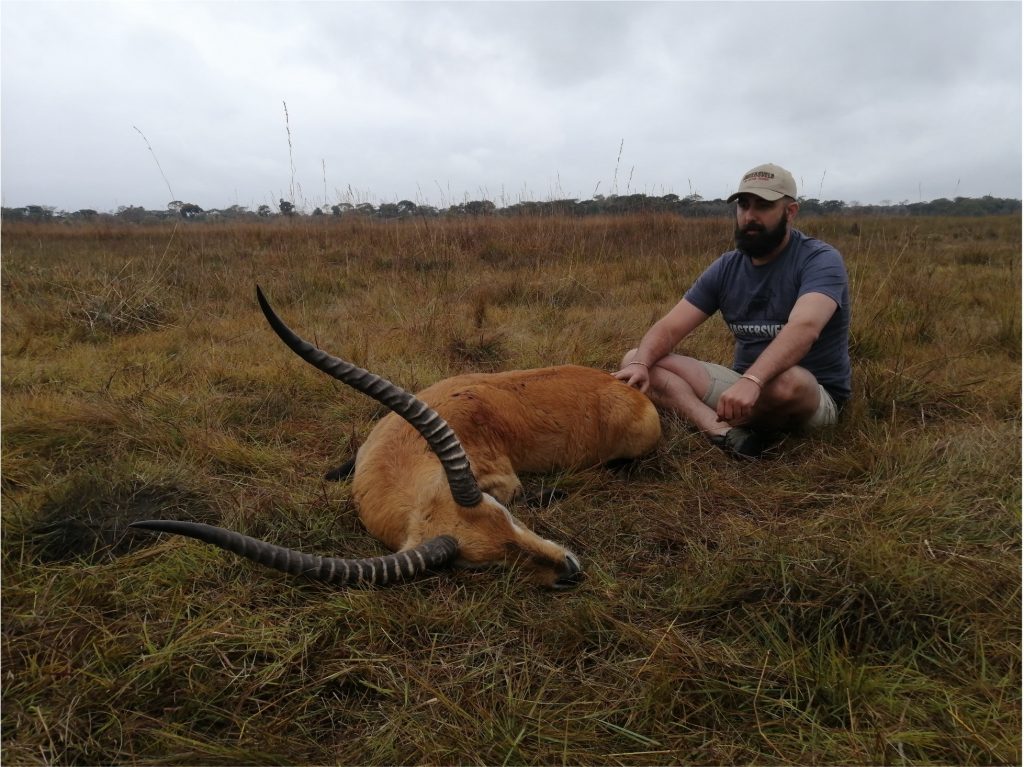
Kevin and I both had our lechwes in the salt before lunch on the first day and had two days left to consume every bit of Mother Nature’s beauty. I have been blessed to see large parts of our world, and I have seen a lot of beautiful places, but I do believe that God spent just a little bit more time when He created Africa.